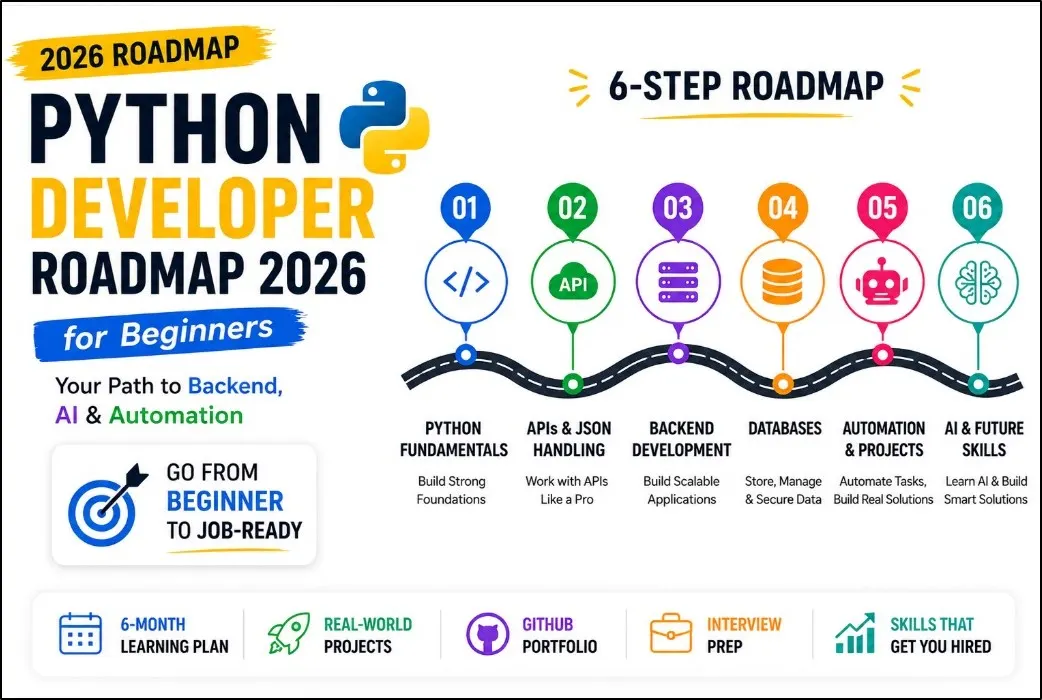
1. Introduction
If you are starting your Python journey in 2026, one thing probably feels overwhelming already.
Everyone is telling you to learn something different.
One YouTube video says learn DSA first.
Another says start with AI immediately.
Someone else tells you to build projects.
Another person says to learn Django, FastAPI, Docker, Kubernetes, LangChain, AI Agents, and Cloud together.
Most freshers and junior developers are not confused because Python is difficult.
They are confused because there is too much advice on the internet.
When I started learning Python, I also wasted a lot of time jumping between tutorials, courses, frameworks, and random coding videos without understanding what actually matters in real-world development.
One thing I realized during my learning journey was this:
You do not need to learn everything together.
You need a proper roadmap.
This Python developer roadmap for beginners is designed specifically for:
- freshers
- self-taught developers
- college students
- junior developers
- career switchers
- aspiring backend developers
- future AI engineers
Instead of giving generic advice, this guide explains:
- what to learn
- what to skip initially
- which projects to build
- when to learn backend development
- when to start AI and AI Agents
- common beginner mistakes
- how to become job-ready step by step
Whether you want to become:
- a Python backend developer
- an automation engineer
- an AI developer
- a freelancer
- or an AI Agent engineer in the future
This roadmap will help you move in the right direction without wasting months on confusion.
2. What You Will Learn in This Python Developer Roadmap
In this complete Python roadmap for beginners, you will learn:
- The best Python learning path for 2026
- What freshers should focus on first
- Python fundamentals that actually matter
- Real-world backend skills
- APIs and JSON handling
- Project-based learning strategy
- Automation using Python
- GitHub and portfolio building
- How to prepare for Python interviews
- When to start AI and AI Agents
- Common mistakes beginners make
- A realistic 6-month Python learning plan
By the end of this guide, you will clearly understand how to become a practical Python developer instead of getting stuck in endless tutorials.
3. Why Python Is Still One of the Best Programming Languages in 2026
Even after so many new technologies and AI tools, Python is still one of the most powerful and beginner-friendly programming languages in the world.
Why?
Because Python is used almost everywhere.
Python is heavily used in multiple areas like:
- backend development
- AI and machine learning
- automation
- APIs
- cybersecurity
- cloud scripting
- data engineering
- AI Agents
- web scraping
- DevOps
- Data Science
Companies continue using Python because:
- it is simple
- readable
- fast to develop with
- supported by huge libraries
- beginner friendly
- production ready
Another major reason Python is growing even faster now is AI.
Most modern AI systems, AI automation tools, and AI Agent frameworks are built using Python.
This means learning Python today is not only useful for backend jobs, but also for future AI opportunities.
4. What Freshers Should STOP Doing Immediately
Before learning what to study, let’s first understand what wastes the most time.
This section alone can save beginners several months.
Stop Tutorial Hopping
Many beginners watch:
- 20 YouTube tutorials
- 5 courses
- random reels
- random GitHub projects
but they never build anything.
Watching tutorials feels productive, but without projects, your confidence never grows.
Learning happens when you:
- make mistakes
- debug code
- fix errors
- build projects
not when you only consume videos.
Stop Learning 10 Technologies Together
You do NOT need:
- Django
- FastAPI
- React
- Docker
- Kubernetes
- AI Agents
- LangChain
- AWS
all in the first month.
You should focus on one layer at a time.
Strong foundations always beat rushed learning.
Stop Memorizing Syntax Only
Many freshers know syntax but cannot solve practical problems.
Real companies care more about following things like:
- logic
- debugging
- APIs
- projects
- understanding data flow
not memorized definitions.
Stop Copy-Pasting Projects Blindly
Please understand that building projects is very important.
But copying projects line-by-line without understanding logic gives almost zero long-term benefit.
Even a small project you understand deeply is more valuable than a huge copied project.
Common Beginner Mistakes vs Better Learning Approach
Many freshers and beginner developers waste months following the wrong learning approach while trying to learn Python, backend development, APIs, and AI together.
The following table explains some common beginner mistakes and a smarter, more practical Python learning strategy for long-term growth.
| Common Beginner Mistake | Better Learning Approach |
| Watching tutorials without practice | Build small real-world Python projects |
| Learning too many technologies together | Master one skill layer step by step |
| Copy-pasting code blindly | Understand project logic and debugging |
| Ignoring GitHub and portfolio building | Build public projects consistently |
| Memorizing syntax only | Focus on problem solving and practical coding |
| Jumping directly into AI tools | Build strong Python and API foundations first |
Now that you understand the common mistakes beginners should avoid, let’s look at the actual step-by-step Python developer roadmap for 2026.
5. Complete Python Developer Roadmap 2026
Now let’s understand the complete step-by-step Python developer roadmap for beginners in 2026.
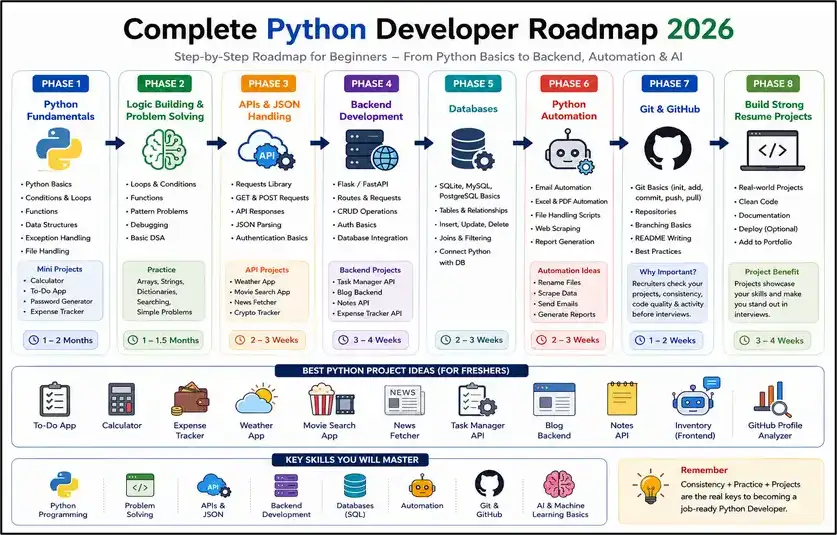
Phase 1 - Learn Python Fundamentals Properly
This is the most important stage. You shouldn’t rush this phase.
Strong Python fundamentals make backend development, automation, and AI much easier later.
Topics You Should Learn
Python Basics
- variables
- data types
- input/output
- operators
Conditions & Loops
- if-else
- for loop
- while loop
- nested loops
Functions
- parameters
- return values
- reusable logic
Data Structures
- lists
- tuples
- dictionaries
- sets
Exception Handling
- try-except
- debugging
- handling errors safely
Learning
Python exception handling properly helps beginners debug errors confidently and build more reliable backend applications and automation scripts
File Handling
- reading files
- writing files
- CSV handling
Projects You Should Build in This Phase
My recommendation is NOT skip projects at this stage.
Even small projects matter.
Beginner Python Project Ideas
- calculator
- expense tracker
- password generator
- student marks system
- to-do app
- number guessing game
- file organizer
These projects help improve your:
- logic building
- debugging
- confidence
Estimated Time
If you practice consistently:
- 1–2 months is enough for strong fundamentals
Phase 2 - Logic Building & Problem Solving
Once you become comfortable with basics, the next step is to improve your thinking ability.
Many beginners fail interviews not because they do not know Python, but because they struggle with logic.
Focus Areas
- loops
- conditions
- functions
- pattern problems
- debugging
- basic DSA
Important Reality About DSA
Freshers often panic after hearing about Data Structures and Algorithms. You do NOT need advanced competitive programming initially.
Start with:
- arrays/lists
- dictionaries
- strings
- basic searching
- simple logic problems
Consistency matters more than solving extremely hard problems.
Phase 3 - Learn APIs & JSON Handling
This phase changes everything. Once you start working with APIs and JSON data, you begin understanding how real-world applications actually communicate
Most real-world applications use:
- APIs
- JSON data
- backend communication
Learn These Topics
- requests library
- GET requests
- POST requests
- API responses
- JSON parsing
- authentication basics
Understanding JSON handling in Python is extremely important because most APIs, backend systems, automation tools, and AI applications exchange data using JSON responses.
Why APIs Are So Important
APIs are used in multiple areas like:
- web applications
- AI tools
- chatbots
- automation
- payment systems
- cloud services
- AI Agents
Understanding APIs early gives you a massive advantage later.
Real Projects You Should Build
API-Based Projects
- weather app
- crypto price tracker
- movie search app
- news fetcher
- AI chatbot frontend
- GitHub profile analyzer
These projects look excellent on resumes.
Phase 4 - Learn Backend Development
Once APIs become comfortable, then you should move into backend development.
You do NOT need to become a full-stack expert immediately.
Start small.
Learn:
Flask vs FastAPI for Beginners
Flask
It is better for:
- absolute beginners
- simple projects
- understanding backend basics
FastAPI
It is better for:
- modern APIs
- performance
- AI systems
- scalable backend services
FastAPI is becoming increasingly popular for modern APIs, automation systems, and AI-powered applications.
Backend Projects You Should Build
Strong Resume Projects
- task manager API
- authentication system
- blog backend
- expense tracker API
- notes API
- inventory management system
These projects build real-world backend confidence.
Phase 5 - Learn Databases
Today, almost every real application stores data. That is why databases are essential.
Start With
- SQLite
- MySQL
- PostgreSQL basics
Learn:
- tables
- insert
- update
- delete
- joins
- filtering
Important Beginner Advice
You do NOT need advanced database optimization initially.
Focus first on:
- connecting Python with databases
- CRUD operations
- understanding data flow
Phase 6 - Learn Python Automation
Automation is one of the most underrated Python skills.
Python automation can help with:
- freelancing
- internships
- productivity
- side income
- scripting jobs
Automation Ideas
- email automation
- PDF automation
- Excel automation
- file renaming
- report generation
- web scraping
Why Automation Is Powerful
Many companies pay developers to automate repetitive work.
Even small automation scripts can save businesses hours of manual effort.
Phase 7 - Learn Git & GitHub
Many beginners ignore GitHub until very late.
This is a HUGE mistake.
Your GitHub profile becomes your public coding portfolio.
Understanding Python modules and packages is also very important because real-world Python projects are organized using reusable modules, clean project structures, and package-based architecture.
Learn:
- git init
- commit
- push
- pull
- repositories
- README writing
Why GitHub Matters
Recruiters often check:
- projects
- consistency
- code quality
- activity
before interviews.
Even small clean projects are valuable.
Phase 8 - Build Strong Resume Projects
Projects are one of the biggest factors that separate beginners from job-ready developers.
The following beginner-friendly Python projects can help you improve practical coding skills, strengthen your GitHub portfolio, and prepare for backend and automation interviews confidently.
6. Best Python Projects for Freshers in 2026
Building real-world Python projects is one of the best ways for freshers to improve practical coding skills and gain real development experience. These beginner-friendly Python project ideas can also help you build a stronger resume, improve your GitHub portfolio, and prepare confidently for Python interviews.
| Project | Skills Learned | Resume Value |
| Expense Tracker | CRUD, logic | Beginner |
| Weather App | APIs, JSON | Strong |
| Chatbot | APIs, backend | Strong |
| File Organizer | Automation | Strong |
| AI Resume Analyzer | AI integration | Very Strong |
| API Rate Limiter | Backend logic | Excellent |
| Password Manager | Security basics | Strong |
| Task Manager API | Backend APIs | Excellent |
7. What Recruiters Actually Look For
Many beginners think:
“Big project = better project”
This is not always true.
Recruiters care more about your:
- understanding
- clean code
- practical logic
- APIs
- problem solving
A small well-built project is far better than a copied large project.
When Should You Start Learning AI & AI Agents?
This is one of the biggest questions in 2026.
The internet makes beginners feel like:
“If I don’t learn AI immediately, I’ll fall behind.”
That is not true.
First Build:
- Python fundamentals
- APIs
- JSON
- backend basics
- automation skills
THEN only, you should move toward AI.
Because AI systems internally depend heavily on:
- Python
- APIs
- backend logic
- structured data
- automation workflows
8. Best AI Learning Sequence for Beginners
If your long-term goal is to become an AI developer or AI Agent engineer, do not jump directly into advanced AI frameworks. Follow this practical learning sequence step by step to build strong foundations first.
Step 1 - Python Fundamentals
Before moving into AI and machine learning, make sure you are comfortable with core Python concepts and practical coding. Topics like variables, loops, functions, lists, dictionaries, file handling, and exception handling create the base for backend development, automation, APIs, and future AI systems.
Step 2 - APIs & Backend
Once your Python basics become comfortable, the next step is learning APIs, JSON handling, and backend development. Modern applications, AI tools, chatbots, and automation systems depend heavily on APIs and backend communication.
Step 3 - Basic Machine Learning Concepts
After learning backend fundamentals, start understanding basic machine learning concepts like datasets, training, prediction, models, and data preprocessing. At this stage, your goal should be understanding how AI systems work instead of becoming an advanced ML engineer immediately.
Step 4 - LLMs & OpenAI APIs
Now you can move toward Large Language Models (LLMs), OpenAI APIs, prompt engineering, and AI-powered application development. This is where Python starts connecting directly with modern AI products, AI automation tools, and real-world generative AI applications.
Step 5 - AI Agents & Workflows
Finally, start learning AI Agents, automation workflows, memory systems, RAG pipelines, and multi-agent architectures using frameworks like LangChain and CrewAI. By this stage, your Python, backend, and API foundations will make advanced AI systems much easier to understand and build confidently.
9. Common Mistakes Freshers Make
Trying to Learn Everything Together
Many freshers try to learn Python, DSA, backend development, AI, cloud, and frameworks at the same time. This creates confusion and burnout, so it is better to master one skill layer before moving to the next.
Avoiding Projects
Watching tutorials alone will not make you job-ready. Real Python projects help you understand logic, debugging, APIs, automation, and backend development in a much more practical way.
Fear of Errors
Errors are not a sign that you are bad at programming. Every Python developer learns by fixing bugs, reading error messages, and improving code step by step.
Watching Tutorials Without Practice
Tutorials are useful, but passive learning slows your growth. After every Python concept, write code yourself, change examples, break them, fix them, and build small projects.
Comparing Yourself Constantly
Every fresher and junior developer learns at a different speed. Instead of comparing your journey with others, focus on consistency, practice, GitHub projects, and improving your problem-solving skills daily.
If you are feeling overwhelmed by too many tutorials and technologies, this step-by-step Python learning plan can help you focus on the right skills in the right order.
10. Suggested 6-Month Python Learning Plan
If you are confused about where to start learning Python in 2026, this practical 6-month Python roadmap will help you focus on the right skills step by step without feeling overwhelmed.
Month 1 - Learn Python Fundamentals Properly
In the first month, focus completely on Python basics and core programming concepts.
Topics to Learn:
- Python syntax
- variables and data types
- input/output
- operators
- conditions
- loops
- functions
- lists
- dictionaries
At this stage, your goal should not be speed. Your goal should be understanding how Python actually works internally.
Practice small coding exercises daily and try writing simple programs without copying code directly from tutorials.
Month 2 - Build Small Projects & Improve Problem Solving
Once your Python fundamentals become comfortable, start building beginner-friendly Python projects.
Focus Areas:
- mini projects
- file handling
- exception handling
- debugging
- basic logic building
Recommended Beginner Python Projects:
- calculator app
- expense tracker
- to-do app
- password generator
- student marks system
This stage is extremely important because projects help you apply Python concepts in real-world situations and improve your problem-solving ability naturally.
Month 3 - Learn APIs, JSON & Backend Basics
In the third month, move toward real-world Python development concepts like APIs and backend communication.
Topics to Learn:
- APIs
- JSON handling
- requests library
- GET and POST requests
- API responses
- backend basics
At this stage, you begin understanding how Python is used in real-world applications and backend systems
Projects You Can Build:
- weather app
- crypto tracker
- movie search app
- news app
- GitHub profile analyzer
These types of API-based Python projects also look strong on resumes and GitHub portfolios.
Month 4 - Learn Flask or FastAPI & Databases
Once you understand APIs and backend basics, start learning a Python backend framework like Flask or FastAPI.
Topics to Learn:
- Flask or FastAPI
- routes
- CRUD operations
- request handling
- authentication basics
- database integration
- SQL basics
You should also start learning databases like:
- SQLite
- MySQL
- PostgreSQL basics
At this stage, your focus should be building complete backend projects instead of only learning syntax.
Month 5 - Learn Automation & Build GitHub Portfolio
Now start exploring Python automation and improve your GitHub profile.
Topics to Learn:
- email automation
- Excel automation
- PDF automation
- file automation
- web scraping
- Git & GitHub basics
Important GitHub Skills:
- repositories
- commits
- push/pull
- README writing
- project organization
A strong GitHub profile can significantly improve your visibility during internships and junior developer interviews.
Month 6 - Build Advanced Projects & Start AI Foundations
In the sixth month, start building more advanced Python projects and prepare for interviews.
Focus Areas:
- advanced backend projects
- APIs with databases
- authentication systems
- interview preparation
- debugging practice
- AI foundations
You can also start exploring:
- machine learning basics
- OpenAI APIs
- prompt engineering
- AI tools
- beginner AI workflows
At this stage, your goal is becoming comfortable with real-world Python development and preparing yourself for backend, automation, and future AI opportunities.
11. How to Prepare for Python Interviews
Preparing for Python interviews is not only about memorizing definitions or solving coding questions. During Python interviews, recruiters usually prefer candidates who can build projects, solve practical problems, debug errors, and explain their logic clearly.
Many freshers focus only on theory, but real Python interviews usually test:
- problem-solving skills
- debugging ability
- project understanding
- APIs and backend basics
- communication skills
Focus on Strong Python Fundamentals
Before learning advanced frameworks, make sure your Python fundamentals are clear.
Important Topics to Revise:
- loops
- functions
- lists
- dictionaries
- file handling
- exception handling
- APIs and JSON basics
Practicing a
Python API quiz for freshers can help improve your API understanding, backend concepts, and interview confidence significantly.
These concepts are commonly asked in Python interviews for freshers and junior developers.
Build Real Python Projects
Projects help recruiters understand your practical coding skills.
Recommended Beginner Python Projects:
- weather app
- expense tracker
- chatbot
- automation scripts
- task manager
- GitHub profile analyzer
During interviews, be ready to explain:
- project logic
- challenges you faced
- debugging process
- API handling
Even small projects can create a strong impression if you understand them properly.
Improve Your Debugging Skills
Errors are a normal part of programming.
Good developers are not people who avoid errors. They are people who know how to read error messages, debug code, and solve problems calmly.
Practice:
- fixing syntax errors
- debugging APIs
- understanding exceptions
- solving logical mistakes
Do Not Ignore Communication Skills
Many freshers underestimate communication during technical interviews.
Even strong technical skills become difficult to showcase if you cannot explain your thought process clearly.
Practice:
- explaining projects confidently
- discussing your logic step-by-step
- communicating technical ideas simply
Interviewers often evaluate confidence, clarity, and problem-solving approach along with coding knowledge.
Golden Advice
Instead of memorizing hundreds of interview questions, focus on:
- strong Python fundamentals
- practical projects
- APIs and backend basics
- debugging confidence
- consistent coding practice
A fresher who can confidently explain real-world Python projects usually performs much better than someone who only memorized theory.
12. Frequently Asked Questions
Can I Learn Python in 6 Months?
Yes, many beginners can learn Python in 6 months if they practice consistently and build real Python projects regularly. Instead of only watching tutorials, focus on coding daily, debugging errors, and working on APIs, backend projects, and automation scripts.
Is Python Enough for AI Development?
Yes, Python is currently one of the best programming languages for AI, machine learning, automation, and AI Agent development. Most modern AI frameworks, OpenAI tools, data science libraries, and AI automation systems heavily use Python.
Should I Learn Django or FastAPI First?
For beginners and junior developers, Flask or FastAPI are usually easier to understand initially because they help you learn APIs, routing, and backend development step by step. Once your backend fundamentals become strong, learning Django becomes much easier.
Do I Need DSA for Python Jobs?
Basic Data Structures and Algorithms (DSA) are important for Python interviews and problem-solving rounds. However, many companies also focus heavily on practical Python projects, APIs, backend development, debugging skills, and real-world coding ability.
Can Freshers Get Jobs Using Python?
Yes, many companies hire freshers and junior developers for Python backend development, automation, APIs, data processing, AI support, and scripting roles. Strong Python fundamentals and practical projects can significantly improve your chances of getting internships and entry-level jobs.
Which Python Projects Are Best for Freshers?
Beginner-friendly Python projects like weather apps, expense trackers, chatbots, automation tools, task managers, and API-based applications are excellent for freshers. These projects help improve problem-solving skills and make your resume and GitHub portfolio much stronger.
Is Python Good for Backend Development?
Yes, Python is widely used for backend development using frameworks like Flask, FastAPI, and Django. Python backend developers work on APIs, databases, authentication systems, automation tools, and scalable web applications.
How Much Time Should I Practice Python Daily?
For beginners, practicing Python for 1–2 hours daily with consistency is usually more effective than studying for long hours occasionally. Regular coding practice, debugging, and project building help improve Python skills much faster over time.
Is Python Good for Freelancing and Remote Jobs?
Yes, Python is one of the best programming languages for freelancing, remote work, automation projects, backend APIs, AI tools, and scripting tasks. Many startups and global companies hire Python developers for remote development work.
When Should I Start Learning AI and AI Agents?
You should first build strong Python fundamentals, APIs, JSON handling, backend basics, and automation skills before moving into AI and AI Agent development. A strong Python foundation makes learning AI tools and frameworks much easier later.
You do not need to learn everything together. You only need consistent progress in the right direction.
13. Final Thoughts
One of the biggest mistakes beginners and freshers make is believing they are “too late” to learn Python, backend development, or AI. The reality is that technology keeps evolving every year, and new opportunities continue getting created for developers who focus on learning practical skills consistently.
You do not need to master everything in one month. Focus first on practical coding skills, real-world projects, debugging, and understanding how modern Python applications work. These are the foundations that make advanced technologies like AI, automation, and AI Agents much easier to learn later.
Python is still one of the best programming languages for:
- modern web applications
- automation
- AI development
- data processing
- cloud scripting
- future AI Agent systems
Most successful Python developers did not become experts overnight. They improved step by step by building projects, making mistakes, fixing errors, and practicing consistently.
So start small.
Build practical Python projects.
Stay consistent with coding practice.
Improve your GitHub portfolio.
And give yourself enough time to grow confidently as a developer.
Your journey does not need to be perfect. It only needs to keep moving forward.